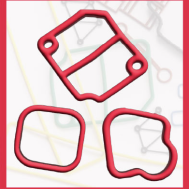
Custom molded enclosure seals, also known as housing seals, work to stop contaminants like dust and water from entering a space. These seals depend on the correct materials, manufacturing processes, and hardness for optimized efficiency. Our blog explores how we create housing seals and why you should consider them for your next project.
Three Main Types of Housing Seals
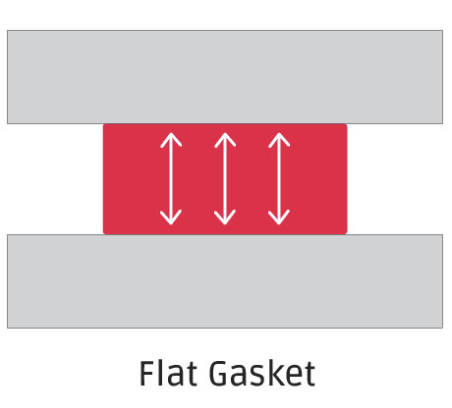
Flat gaskets are used between two stationary surfaces, hence the name. They are used only for static joints (when two components that fit together do not move when in use) and prevent dust or other contaminants from leaking. Key characteristics of the seals are that they’re simple in design configuration and have a tighter tolerance than die-cut gaskets. Flat gaskets are best for simple sealing applications with uniform surfaces and retrofitting solutions for existing designs.
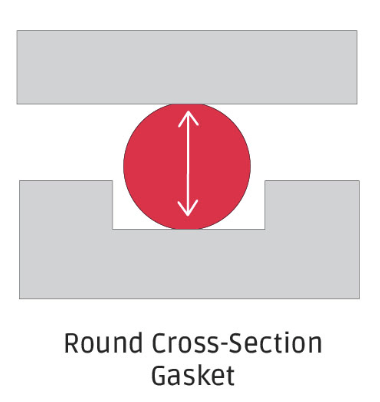
Round cross-section gaskets create a higher load point (stress) with a lower compressive force, resulting in a better seal between the bulk elastomer and the mating surface. The lower compressive force needed to compress the seal can minimize it from changing shape under pressure. These gaskets offer concentrated sealing pressure for improved performance, superior ability to absorb component tolerances, and lower fastener torque requirements due to efficient load distribution. These gaskets are often used in environments with temperature fluctuations, applications requiring superior force, and designs demanding consistent compression.
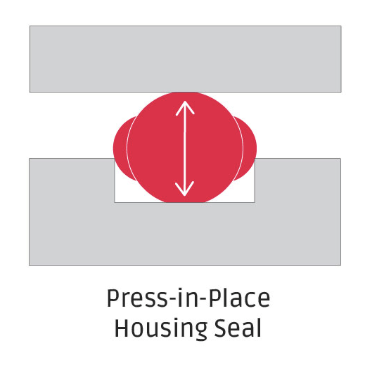
Press-in-place housing seals are custom-engineered to be slightly larger than the housing groove (known as sidewall interference). These seals are named for the installation method of pressing them into a machined groove; no stretching or adhesives are necessary. These seals offer the best of the bunch: a simplified assembly process, a ribbed design to prevent seal displacement, consistent positioning during installation, and the combination of the sealing advantages of round cross-sections with secure positioning. These seals are ideal for complex housing configurations, environments with movement or vibration, and designs that are assembly-friendly.
What They’re Made Of
Material choice is important for housing seals because different types have their own benefits. Potential options include nitrile (NBR), ethylene-propylene (EPDM), and silicone (VMQ). For example, VMQ may be used because of its temperature resistance of -85ºF to 400ºF (-65ºC to 204ºC) and its flexibility; NBR is great for its resistance to hydraulic fluids, oils, and fuels; and EPDM is used for its weatherproofing and ability to dampen vibration.
Choosing the right material for your housing seal is ideal to prevent premature failure, contaminant or fluid leakage, and potential equipment damage if the seal isn’t effective. You’ll need to consider your specific needs, such as the chemicals the seal may be exposed to, temperatures, and the necessary compression set.
Options for Advanced Customization
Apple Rubber offers advanced material options and customization. We have a full range of elastomers, including NBR, EPDM, and VMQ; durometer (hardness) options from 20 Shore A (soft and flexible, like a rubber band) to 80 Shore A (medium-hard to hard, like a shoe heel), all of which are dependent on the selected material; and custom color matching available in both opaque and translucent variations.
For speciality formulations, we can utilize ultraviolet-stabilized materials for outdoor applications that are frequently exposed to sunlight; anti-fungal compounds that resist fungal growth; and medical-grade seals that are tested to the standards of the United States Food and Drug Administration (FDA).
How We Make Your Housing Seals
At Apple Rubber, we know how to manufacture excellence. This includes our liquid silicone rubber (LSR) processing. LSR offers numerous benefits: near-zero flash production, which requires minimal post-processing and lowers the risk of leakage; dimensional consistency, so every seal has nearly identical measurements for reliable seal compression; the capability to mold intricate features and undercuts, allowing the seals to fill complex mold cavities; and rapid cure kinetics, enabling more efficient, higher-volume production.
We also use rubber injection molding as part of our production processes. These capabilities allow for: sustainable manufacturing with lower material consumption, lower scrap rates, and less rubber per part; higher automation, resulting in low defect rates and better sealing reliability; repeatable cycles to ensure consistent seal compression; and automated injection for superior consistency and uniform dimensions.