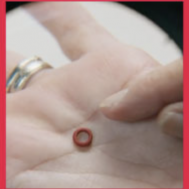
Sometimes, the smallest things can have the biggest impact. That’s especially true for rubber seals. At Apple Rubber, we manufacture a variety of seal sizes, from the large-diameter macrOrings® to more conventional, everyday o-rings. Even when it comes to the smallest size you can imagine, we have a seal for that: micrOrings®. Read on to find out more about them.
What Exactly Are MicrOrings?
A micrOring seal is any o-ring that measures less than 1 mm in either inside diameter (I.D.) or cross section (C.S.). Regular o-rings range in I.D. from .029” to 26” (.74mm to 658.88mm) and in C.S. (width) from .040” to .275” (1.02mm to 6.99mm); micrOrings, at their smallest, have an I.D. or C.S. of 0.008” (0.20mm), and at their largest, 0.039” (1.0mm). MicrOring seals are used across a variety of industries, including medical devices, aerospace technology, and fiber optics.
How Apple Rubber Makes MicrOrings
MicrOrings require a unique and careful manufacturing process. First, we make a mold in our advanced mold shop, which is dedicated solely to micro-mold manufacturing. We have many specialized machining centers that use high-speed spindles to machine the micro-mold’s cavity features. This high speed lets us use extremely small cutters without the need for expensive electrical discharge machines.
Next, the mold enters a micro-molding press to make the seals; this offers tight controls for producing parts to strict tolerances. Then, the parts are inspected; their miniature nature makes this difficult, sometimes leading to non-fills being overlooked. To remedy this problem, we have refined non-contact manufacturing equipment to make sure any seals coming through are reviewed to the utmost standards. In addition, we perform numerous quality control checks for factors like elongation and tensile strength.
Why You Should Consider Using MicrOrings
MicrOrings have multiple benefits. They provide low- and high-pressure capabilities; sealing force resiliency; allowance for precision sealing in tight spaces and delicate assemblies thanks to being designed for micro-scale operations; fit well within tight tolerances; and are tailored for complex, precision-critical operations, offering all of the sealing effectiveness of a regular sized o-ring on a smaller scale.
At Apple Rubber, we have a lot to offer in the microminiature field, such as: the most extensive selection of o-ring sizes in the industry; unmatched experience that comes from no other company or entity possessing the same amount of knowledge and expertise as us in custom engineered sealing solutions; and nonstop innovation, demonstrated by our commitment to increasing our knowledge and abilities in the world of microminiature seals.
Where You Can Find MicrOrings in the Wild
Look anywhere (closely) and you’ll find a field where micrOrings are used. In medical devices like insulin pumps, infusion sets, and catheters; consumer electronics of smartphones, tablets, and wearable devices; the automotive sector of sensors, engine control systems, and actuators; industrial automation, like valves, connectors, and pneumatic systems; and aerospace and defense, like the electronic systems used on aircrafts, satellites, and military electronics, as well as in hydraulic and fuel systems.
With that many uses comes as many types of materials for micrOrings. It’s important to consider the material you want to use for a micrOring, as well as its hardness and desired temperature range. This is applicable for standard and larger size rings, and is also true for smaller ones; in fact, it can be more important to know for micrOrings because, as mentioned earlier in the blog, their size can make it harder to identify breakage. Depending on your industry and environment, as well as the temperature and chemical exposure, material selection is incredibly important.
There are many common materials used for micrOrings. Nitrile has a temperature range of -40ºF to 257ºF (40ºC to 125ºC) and provides high tensile strength and great resistance to hydraulic fluids and water. Ethylene propylene diene monomer is good for -40ºF to 275ºF (-40ºC to 135ºC) and has effective resistance to steam and hot water. Silicone can perform within -85ºF to 400ºF (-65ºC to 250ºC) and is highly resistant to sunlight and ozone, non-toxic, and performs well in high, dry heat.
Neoprene excels within the range of -40ºF to 250ºF (-40ºC to 121ºC) and has great resistance to oil, while offering a good compression set. Fluorocarbon combines high-temperature toughness with wide chemical agent compatibility, along with excellent resistance to petroleum products and solvents, all with a range of -13ºF to 446ºF (-25ºC to 230ºC). Fluorosilicone is suitable for exposure to ozone, sunlight, and air, and features good compression set and resilience properties, with a temperature range of -75ºF to -400ºF (-60ºC to 200ºC).
A Small Ask
Need a micrOring for your next project? Reach out to us, and we’ll work with you to get the perfect seal.