
Seals can fail. It’s as simple as that. What can be challenging is determining the reason. Two common forms are abrasion and spiral failure, and both can have an adverse impact on operations. At Apple Rubber, we want you to know how to identify these issues and the ideal troubleshooting procedures.
What to Know About Abrasion
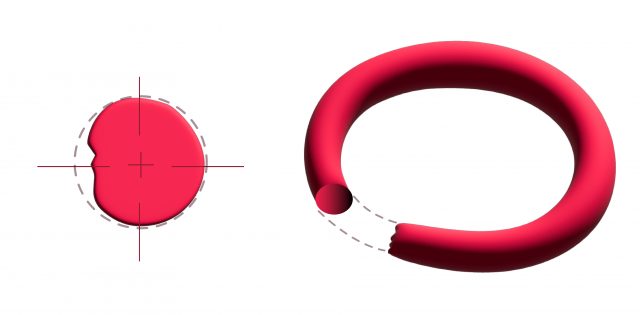
Above shows the failure pattern of o-ring abrasion.
Rubber abrasion occurs when frictional forces, sliding, rolling, or particle impact gradually wear away and remove material from a rubber surface. For instance, significant friction between a surface and an o-ring causes the rubber to degrade and ultimately tear. This issue can be identified by its distinct failure pattern, characterized by a flattened surface along one side of the o-ring’s cross-section.
The primary causes of abrasion encompass rough surface finishes, where metal cuts or tears the rubber to accelerate wear; inadequate or improper lubrication, which elevates friction and thermal stress; elevated temperatures that cause rubber to soften or crack, triggering degradation over time; and system contamination or clogging due to dirt and debris buildup.
Abrasion risk can be mitigated through several measures: Using o-rings manufactured with internal lubricants like natural fatty acids, waxes, and paraffins can help resist friction; applying external lubrication directly to the o-ring; contamination control by installing wiper seals and filters to prevent or clear out abrasive contaminants; and optimizing metal finishes to ensure mating surfaces avoid extreme roughness and excessive smoothness, as both conditions promote abrasion.
Selecting appropriate materials is one of the most effective methods for preventing abrasion. Carboxylated nitrile (XNBR) and polyurethane represent two optimal choices. XNBR provides exceptional wear resistance thanks to added carbon, which enhances structural integrity and friction resistance, while performing within temperature ranges of -20ºF to 302ºF (-30ºC to 150ºC). Polyurethane operates within -30ºF to 175ºF (-34ºC to 79ºC) and provides significant abrasion resistance, and thanks to its elasticity is well-suited for applications with highly-stressed components.
What to Know about Spiral Failure
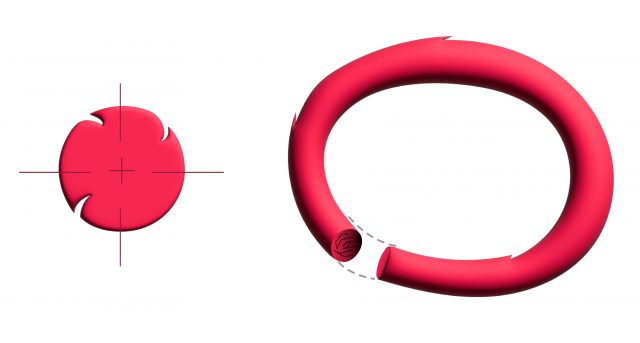
Spiral failure happens when certain segments of an o-ring roll while others slide at the same time. This causes the o-ring to twist against cylinder walls or catch on adjacent components, producing deep 45-degree spiral surfaces and angle cuts. Typically, this type of failure pattern develops in long-stroke hydraulic piston seals.
Several factors contribute to spiral failure. Component misalignment involves eccentric parts like misaligned bearings or couplings leading to uneven o-ring compression and premature wear; similar to seal abrasion, insufficient lubrication elevates friction and heat buildup; and excessively wide clearance combined with side loads can deform and damage the rubber.
Actions can be taken to address spiral failure. You can reduce the clearance gap to minimize the potential for extrusion; use internally- or externally-lubricated o-rings to decrease friction; adjust o-ring dimensions and hardness by increasing their cross section or extrusion resistance; check for an out-of-round cylinder bore to resolve issues with eccentric components; and use anti-extrusion back-up rings to help mitigate the impact of pressure and eccentricity.
Optimal materials for mitigating spiral failure possess exceptional resistance to frictional wear, such as polyurethane and XNBR. Rubbers engineered with high durometer hardness typically exceeding 70 Shore A offer robust strength to withstand severe pressure and wear. Additionally, other nitrile formulations, including standard nitrile and hydrogenated nitrile (HNBR), serve as excellent alternatives.
How We Can Help You
If you have any questions about abrasion, spiral failure, or anything else about rubber, our team is happy to help you. Or, if you’re looking for the perfect o-ring for your next application, find it through our material selection guide.