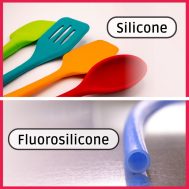
Do you know the differences between silicone and fluorosilicone? Yes? You’re probably lying. Beyond the fact that one has “fluoro” in its name, there’s a lot to understand. Our latest blog provides a breakdown and shows where you can find these synthetic rubbers.
All About Silicone
Silicone is one of the most well-known synthetic rubbers. It offers excellent temperature resistance, able to withstand highs of 400°F (204°C) and can be formulated to endure extreme lows of -148°F (-100°C). It is also praised for maintaining flexibility and its superb dampening properties, meaning it can absorb shock and vibrations. Silicone comes in a range of hardness levels, from soft to hard.
Silicone has the ability to be custom-formulated. It can be compounded to comply with the U.S. Food and Drug Administration (FDA) regulations for pharmaceutical, medical, and food applications. This indicates that the silicone is non-toxic, making it suitable for these highly regulated fields. The customizability of silicone means it can have specific additives solely formulated to help maximize efficiency in specific industries, like the automotive field. Additionally, silicone is much more affordable than fluorosilicone, making it a popular #choice for general purposes. It’s also more readily available.
What About Fluorosilicone?
Fluorosilicone is a modified type of silicone rubber. Fluorine is added to the silicone polymer backbone to impart additional polarity, making fluorosilicone resistant to fuels, oils, and harsh chemicals. Fluorosilicone performs well in low temperatures down to -76°F (-60°C), but not as well as phenyl silicone, which can go down to -148°F (-100°C). The addition of fluorine to the structure of fluorosilicone (which is absent in regular silicone) makes it highly regarded for its range of resistances.
The hardness of fluorosilicone can range from medium soft to hard. However, it is significantly more expensive than silicone—often about five times the cost—mainly because of the added fluorine. Its high resistance properties and cost mean it is typically used in more technical and demanding environments rather than everyday applications.
Where You Can Find Them
As previously mentioned, silicone is widely used in pharmaceutical, food, and medical fields. Common examples include kitchen utensils like oven mitts and spoons, drug manufacturing and packaging, and medical devices such as catheters, prosthetics, tubing, and sterilization tools. For situations requiring flexibility, non-toxicity, and broad availability, silicone is an ideal choice.
Conversely, fluorosilicone, with its enhanced resistance and higher cost, is mainly found in specialized industrial settings. These include aerospace applications with jet fuel, petroleum systems with oils, chemical environments involving chlorinated substances, and various manufacturing machinery. Typically, fluorosilicone isn’t used by individuals but rather by large companies involved in high-performance industries.
We Have You Covered
Looking to use silicone or fluorosilicone in your next project? Our expert engineers can ensure you get exactly what you need.