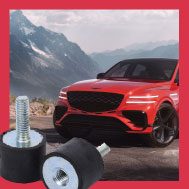
Industrial machinery can be its own beast. Large, loud, and intimidating, it takes many forms and helps manufacturers and businesses in other sectors achieve their goals. But anyone can tell you these machines produce enough vibration and noise to be disruptive to individuals and results. That’s where rubber can come into play.
Causes of Vibration and Noise
Although no two machines and their operations are alike, the issues that affect them, like vibration and noise, are common. Vibration can be caused by looseness in bearings or parts, machine degradation in gears, and a machine component’s center of mass being imbalanced. Using power tools or other industrial instruments with heavy vibrations can also cause problems for the user. Check vibration sources when possible, as manufacturing equipment isn’t meant to actually cause it.
Noise can come from regular machine operation, like using grinders or heavy machinery. It can also result from worn brake pads, which can cause screeching sounds. The same vibration as defined above can cause industrial noise. While noise is expected to occur in the manufacturing process and from industrial equipment, the amount emitted and its duration can cause damage to the user or individuals within the range of the sound.
The Human Impact
Vibration can cause severe health complications, like hand-arm vibration syndrome (HAVS) and whole-body vibration (WBV). HAVS is caused by the prolonged use of vibration-heavy tools like sanders. It can damage blood vessels and nerves, leading to numbness and tingling. WBV comes from the frequent shaking of a machine’s floor or seat, often from excavators and bulldozers. WBV may result in back pain and joint problems, as well as affect blood circulation.
Industrial noise pollution is a result of loud volume, defined as excessive sound from industrial activities. Prolonged exposure causes temporary (and eventually permanent) hearing loss, poor mental health, high stress, and low productivity. Using a measurement known as decibels A (dBA) that focuses on the human ear’s sensitivities to various frequencies of sound, many pieces of machinery surpass 80 dBA, at which point hearing damage is possible. To name a few types of industrial equipment in terms of dBA, dust collectors range from 80–90, and vibratory screens go from 110–120.
How Rubber Solves the Problem
Put simply, to eliminate or lessen vibration, rubber absorbs and dissipates the energy created by vibrations, stopping it from spreading to other areas. Rubber’s elasticity allows it to stretch and compress to reduce the vibrations. Components like anti-vibration mounts are fastened to machines to lessen unwanted vibrations. Gloves specifically designed to absorb and dampen vibrations are used for HAVS prevention for individuals using power tools or equipment like grinders. Anti-vibration pads can be used on machinery to absorb shock. Floor mats can also protect users from heavy vibrations while they operate machinery.
In terms of noise, rubber sheets can be effectively used for soundproofing. There are different types of sheets that can be used, from noise-reducing choices to absorb sound and lower noise, and industrial soundproofing ones to decrease loud noises. Individuals can wear noise-isolating or canceling headphones that have a high noise reduction rating (NRR) or offer active noise cancellation; these headphones frequently use rubber on the ear cups to block outside sounds.
The Types of Rubber to Use
To dampen vibration, primary choices include the synthetic rubber ethylene propylene diene monomer (EPDM) because of its adhesion and resistance to heat and weather; butyl rubber with its excellent shock-dampening qualities; and neoprene with its oil resistance and durability in industrial settings. Silicone rubber is also a great choice for dampening while giving a wide temperature operating range. Neoprene or EPDM are top choices for anti-vibration mounts; neoprene again for use in gloves to prevent HAVS; butyl rubber for pads; and natural rubber, neoprene, or EPDM for floor mats.
Noise, like vibration, has many choices when it comes to the rubber used in these tools. Sheets can have natural rubber because of its ability to stretch, or neoprene for its oil resistance. For headphones, silicone rubber helps form the seal that surrounds the ear and creates a tight barrier for hearing protection. Silicone is also used for flange earbud tips that, while not surrounding the ear like headphones, are placed in the entrance of the ear canal to isolate sound and form a sort of blockage, so sound is reduced as it travels through the ear.
Contact Us
For your rubber-focused industrial needs and projects, please feel free to reach out to us! Or if you’re looking for a specific o-ring, our website’s search capabilities may have just what you need.