
O-rings, just like plants, need to be in the right setting to thrive. That’s why it’s important to understand the environmental characteristics that your o-rings will need to perform in. Think of factors like seal squeeze, chemical compatibility, and temperature. If you don’t have an understanding of the impact each of those can have on o-ring performance, read our blog to learn all about it.
Seal Compression and Chemical Compatibility
Also known as “squeeze,” o-ring seal compression happens because of three factors: the cross-section (which is the size of the o-ring), the hardness of the ring, and the force that is applied to compress (or squeeze) the seal. The stretch of the o-ring greatly affects seal compression through the reduction of the cross-section, meaning the o-ring has less available size, thereby reducing its effective sealing potential.
Chemical compatibility is another important factor. If an o-ring’s basic composition is not well-suited to a chemical environment, it will fail. That’s why an important step in selecting an o-ring is to match the chemicals used in an application to the o-ring material that provides the best resistance to that substance. A good resource is our O-Ring Chemical Compatibility Guide*, which lists materials and chemicals with exposure ratings. For example, diphenyl oxides are good with fluorocarbon but poor with butyl; pinene is fair with fluorosilicone but questionable with chloroprene.
What About Friction?
There are two main types of friction. The first is breakout friction. This should be considered in applications with irregular motion, as it can cause high hydraulic pressures to develop and tear portions of the seal. The second is running friction, often found in continuously moving machines. It can cause heat to accumulate and swell the o-ring, eventually leading to seal failure.
Many methods can address this. You can use a squeeze to reduce both types of friction. Decreasing hardness reduces breakout friction while increasing hardness reduces running friction. Consider using an o-ring with a smaller cross-section, as this can produce less friction. You can also decrease the system pressure to lower the amount of running friction. Rubber can be compounded with additives like oils to lower the coefficient of friction.
O-Rings and Differential Pressure
Differential pressure acts on an o-ring, forcing it toward the low-pressure side of the gland and causing distortion of its cross-section. If the o-ring cannot withstand increasing pressure, part of it will be forced into the gap caused by the distortion. This can lead to leakage, premature failure, and system contamination.
To prevent o-ring extrusion under pressure, methods include increasing o-ring hardness, reducing the diametrical clearance gap dimension, or using backup rings to support the o-ring. Backup rings are washer-like devices made of a relatively hard, tough material, installed in the gland on the downstream side of the seal to prevent seal extrusion into the dimensional gap under pressure.
Impact of Hot and Cold Temperatures on O-Rings
Excessive heat can make o-rings non-functional by chemically or physically degrading them. It can also make the materials swell and harden, permanently deforming their shape within the gland. On the other end, if a material isn’t sufficiently resistant to extreme cold temperatures, the o-ring can leak or shrink due to reduced surface contact. It can also make them less flexible and brittle.
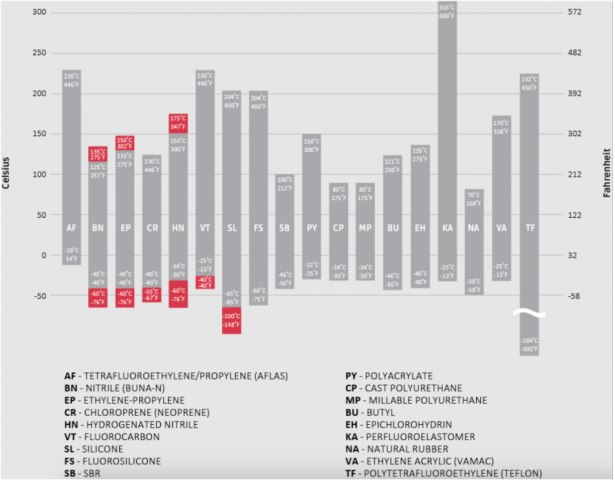
The visual below highlights the typical o-ring material working temperature ranges. The highest temperature a material reaches is 600ºF (316ºC), which is perfluoroelastomer; the lowest a material reaches is -300ºF (-184ºC), courtesy of polytetrafluoroethylene. Many of the most common materials used in o-rings are included in the visual, such as silicone, ethylene-propylene, and butyl. You should know the temperature range you’re operating in and select a material that can handle it.
A Compatible Partner
We’ve been trusted for decades to help manufacture and provide o-rings across multiple industries. No matter the environment, we have an o-ring for it. Our engineers are ready to work with you.
*NOTE: Regarding chemical compatibility, the tool serves as general guidelines only; any seal you select should be rigorously tested in the actual application before production use. It’s important to note that any comments, suggestions, and recommendations in this blog are necessarily general and should not be relied upon without independent verification for the particular installation or use.